Lecture 3

Summary of Externality Theory

Byeong-Hak Choe

SUNY Geneseo

September 4, 2026

🌲 From Market Clearing to Social Cost

🪵 Start with Lecture 2’s Timber Market

  • Buyers’ willingness to pay is the marginal benefit of another truckload: \[ MB(Q)=50-0.5Q. \]

  • Sellers’ marginal harvesting and delivery cost is \[ PMC(Q)=20+Q. \]

  • The annual market clears where \(MB=PMC\): \[ Q_M=20,\;P_M=40. \]

  • That result counts the buyers and sellers—but is anyone else affected?

👥 Timber Harvest Can Affect Third Parties

Timber harvesting on a forested slope sends sediment-laden runoff into a stream used by fish, recreationists, and downstream water users.

  • Logging can increase runoff, sediment, and water-temperature stress.

  • Downstream water users, recreationists, and people who value habitat may bear part of the harm.

  • They are outside the timber transaction, so their loss may be absent from the market price.

  • A negative externality is a cost imposed on others that is not included in the private market decision.

  • Estimating those values is difficult, but leaving them out does not make them zero.

Positive externality

A positive externality is an unpriced benefit received by others.

🧮 Add External Marginal Cost to Private Cost

  • Suppose the external marginal cost is:

    \(EMC(Q)\) \(=\) \(7.5\)

    • In other settings, the harm from one more truckload can change as harvest changes, so \(EMC(Q)\) need not be constant.
  • Social marginal cost counts both costs of another truckload:

    \(SMC(Q)\) \(=\) \(PMC(Q)+EMC(Q)\)

    \(=\) \((20+Q)+7.5\)

    \(=\) \(27.5+Q\)

📉 Private and Social Cost Part Ways

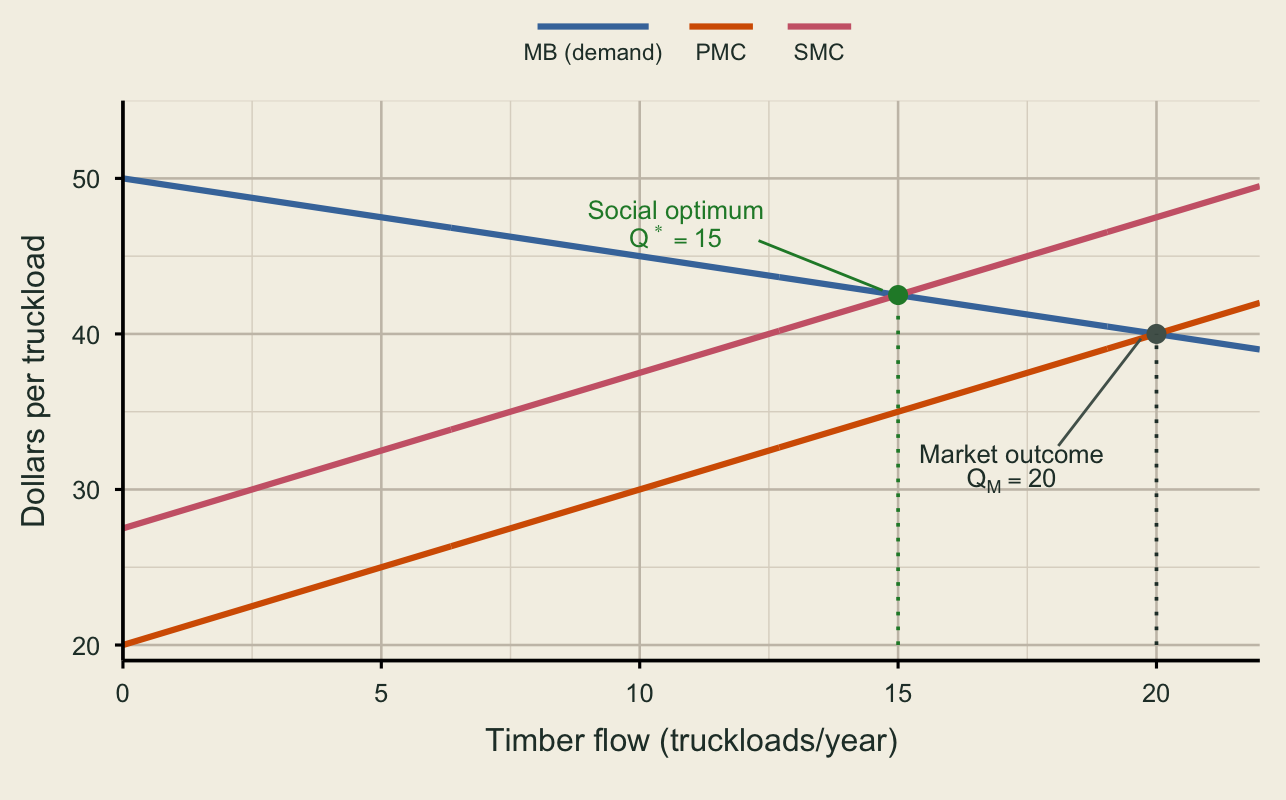
Timber marginal benefit slopes downward. Private marginal cost and social marginal cost are parallel upward-sloping curves separated by a constant external marginal cost of 7.5. The socially optimal outcome is Q star equals 15, while the private-market outcome is Q subscript M equals 20.

  • Market decision: compare \(MB\) with private marginal cost \(\rightarrow Q_M=20\).

  • Social decision: compare \(MB\) with the social marginal cost \(\rightarrow Q^*=15\).

🧾 Internalize the Omitted Cost

🧾 A Pigouvian Tax Prices the Marginal Harm

  • A Pigouvian tax is a per-unit corrective tax designed to make the decision-maker account for the external marginal cost.

  • At the social optimum, set the per-truckload tax equal to external marginal cost: \[ \boxed{\tau^*=EMC(Q^*)} \]

    • In this example, \(\tau^*=7.5\).
  • Equate marginal benefit with the tax-inclusive private marginal cost:

\(MB(Q)\) \(=\) \(PMC(Q)+\tau^*\)

\(50-0.5Q\) \(=\) \((20+Q)+7.5\)

\(22.5\) \(=\) \(1.5Q\)

\(Q^*\) \(=\) \(15.\)

📊 The Corrective Tax Aligns the Private Choice
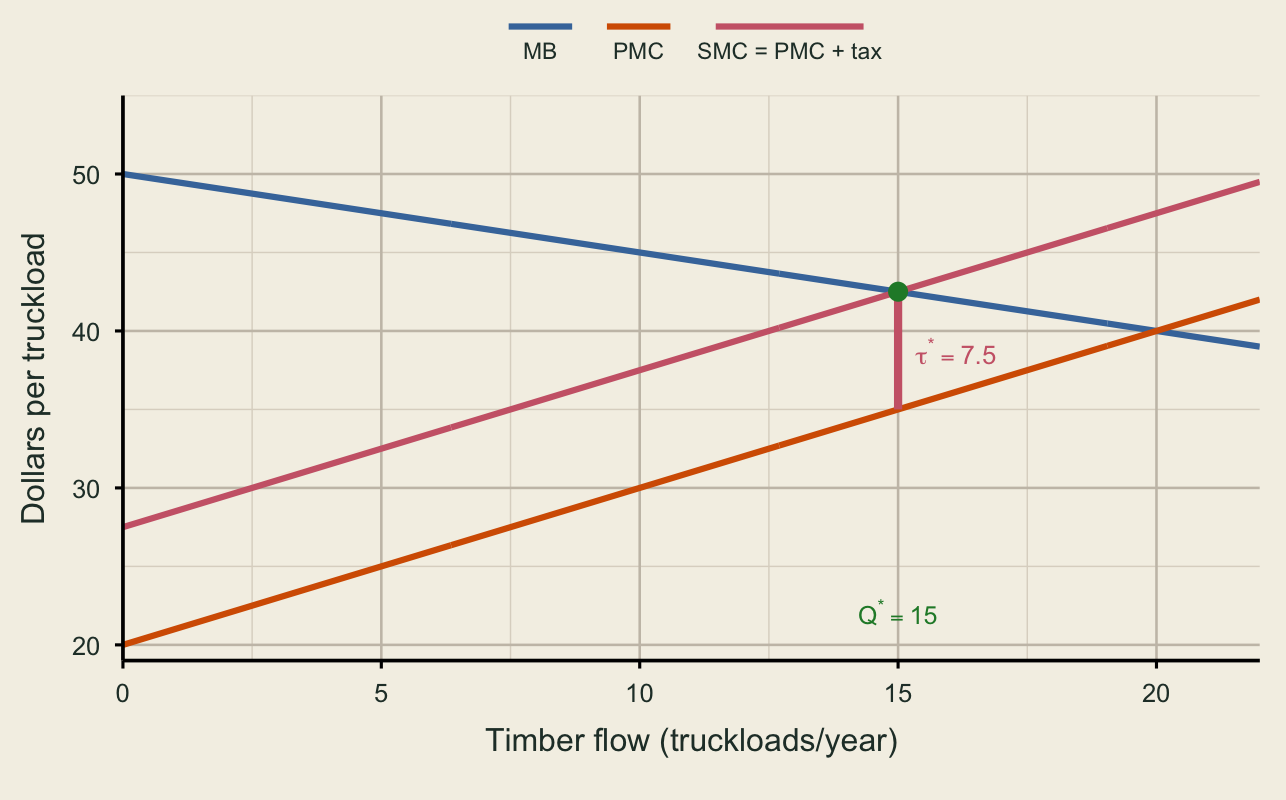
Demand, private marginal cost, and a social marginal cost curve equal to private marginal cost plus a constant 7.5 tax are plotted. The tax-inclusive curve meets demand at the efficient quantity of 15.

  • Because \(EMC\) is constant in this example, the 7.5 tax shifts \(PMC\) to \(SMC\) at every quantity.

📊 Count Welfare, Not Only Market Surplus

📐 Total Damage Is the Area Under EMC

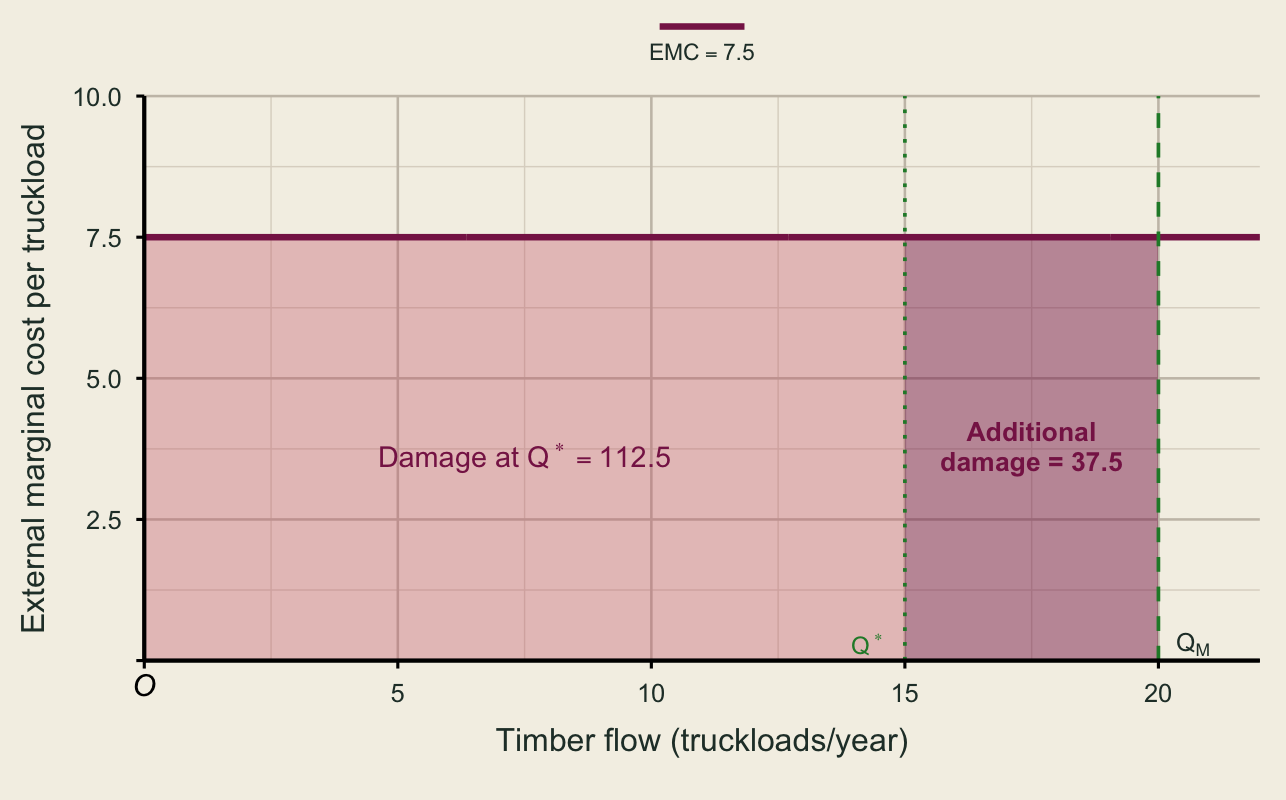
A horizontal external marginal cost curve at 7.5 is shown above two adjoining shaded rectangles. The area through the efficient harvest of 15 is labeled 112.5, the additional area through the market harvest of 20 is labeled 37.5, and their total is 150.

  • With constant \(EMC\), every truckload adds 7.5 of external harm; the two shaded areas sum to market damage of 150.

📐 Total Damage Between PMC and SMC
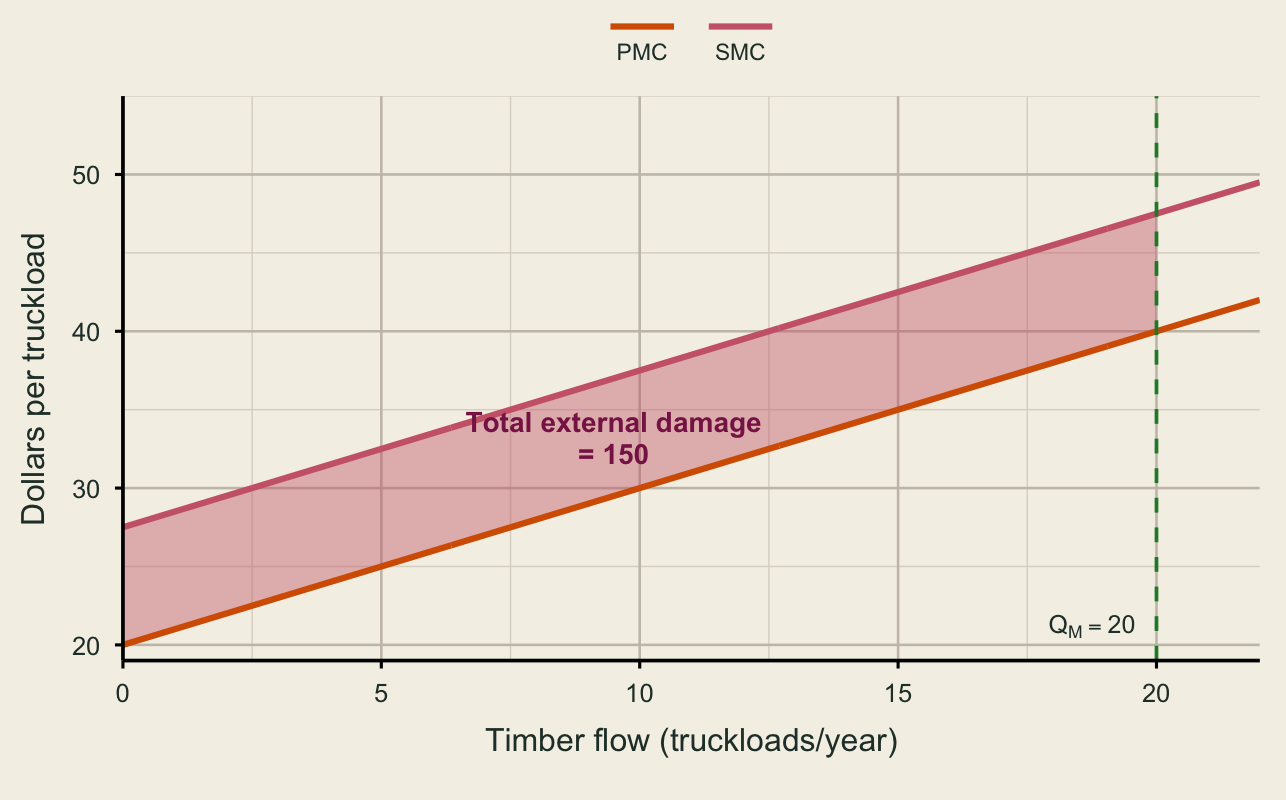
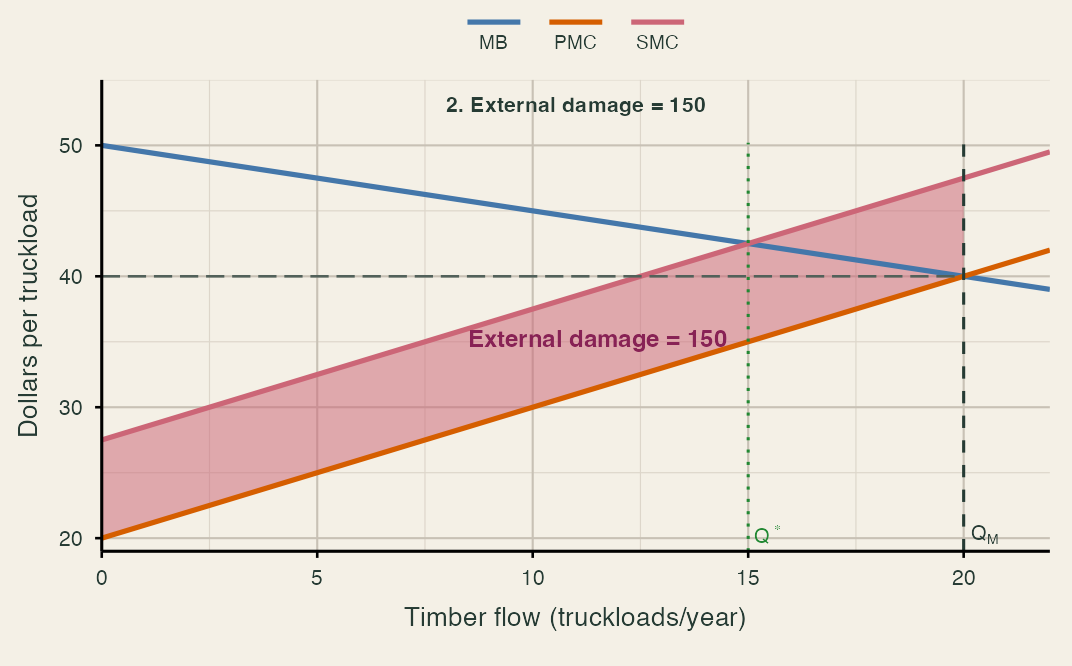
Private marginal cost and social marginal cost are parallel upward-sloping curves. The shaded area between them from zero through the market harvest of 20 truckloads represents total external damage of 150.

  • At each quantity, the vertical gap \(SMC-PMC\) is the external marginal cost of one more truckload.

  • Adding those gaps through \(Q_M=20\) gives total external damage of 150.

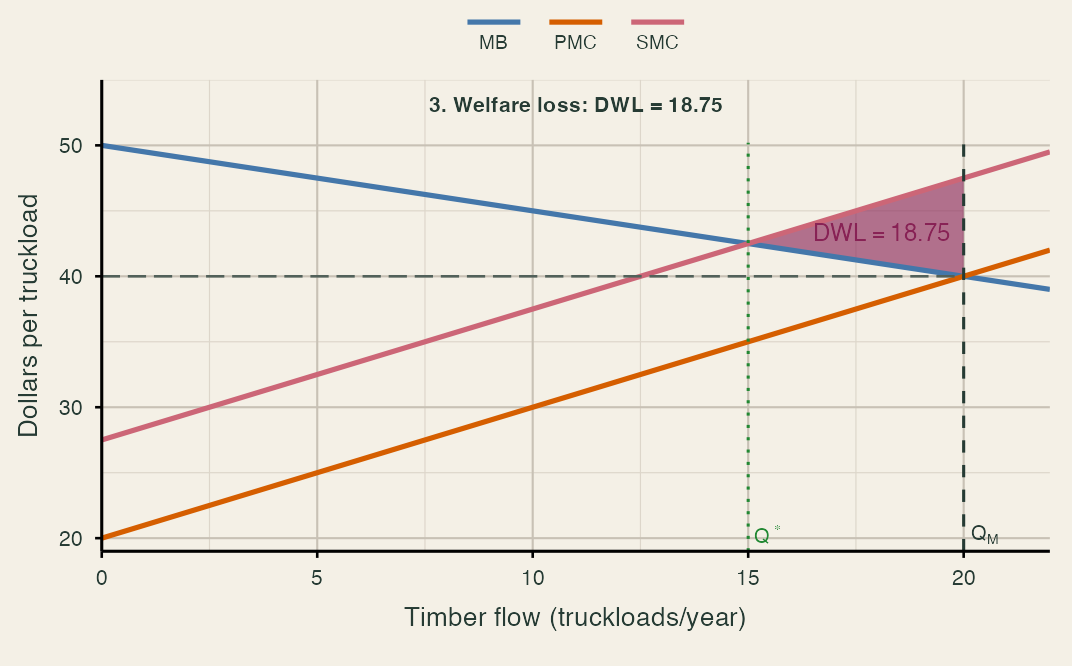
🔍 Total Damage and Deadweight Loss Are Different
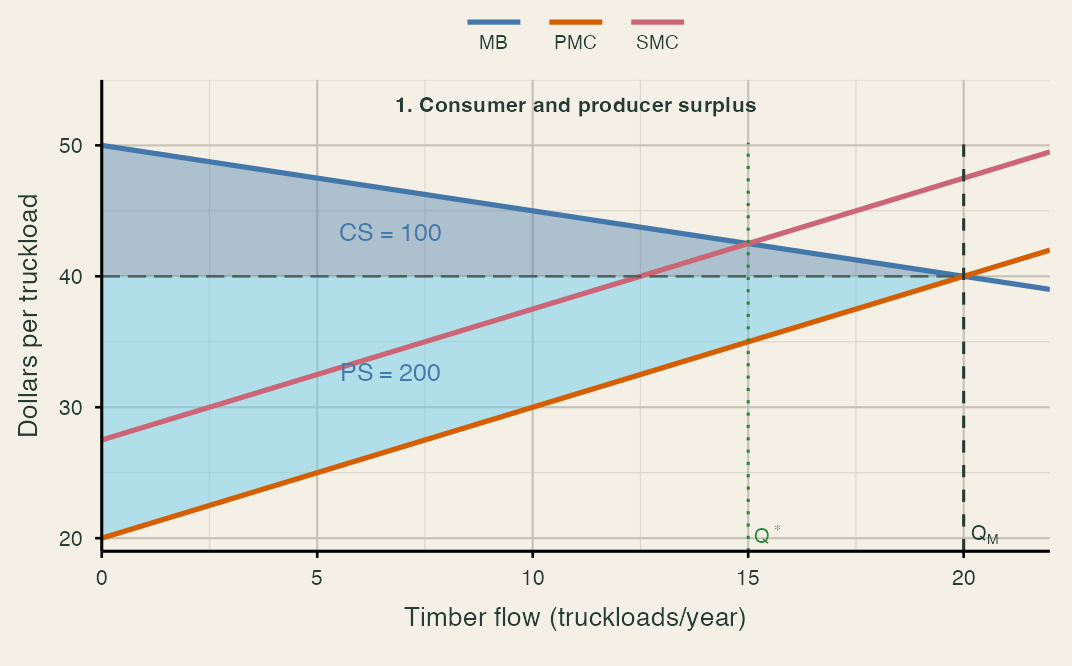
At the unregulated market outcome, tax revenue is zero: \[SW_M=CS+PS-(\text{External Damage})=100+200-150=150.\]

⚖️ Social Welfare (SW) Counts CS and PS Separately

Grouped bars compare consumer surplus, producer surplus, tax revenue, external cost, and social welfare at the private-market outcome Q subscript M equals 20 and the social optimum Q star equals 15. Social welfare rises from 150 to 168.75.

  • Social welfare: \(SW=(CS+PS+\text{Tax Revenue})-(\text{External Cost})\).

🌱 Efficient Harvest Does Not Mean Zero Harvest

  • Eliminating all harvest would also eliminate the benefits from timber use.

  • Efficiency balances the benefit of the next truckload against its full social marginal cost.

  • At \(Q^*=15\), the model still has positive harvest and external damage.

What Shapes Market Outcomes and Welfare

  • An economy begins with endowments—the scarce resources initially available; preferences shape demand and marginal benefit (\(MB\)); and technology shapes supply and marginal cost (\(MC\)).

  • Taking prices as given, consumers maximize utility and firms maximize profit; market-clearing prices coordinate those choices to determine market equilibrium and welfare.

  • Externalities must also be counted to identify the socially efficient harvest.

🧰 Different Policies Need Different Information

Policy What changes the decision? What must be known or enforced?
Pigouvian tax Adds omitted harm to the private marginal cost External marginal cost per truckload; here, 7.5
Harvest quota Caps annual timber harvest at the social optimum, \(Q^*=15\) Quantity monitoring and access to the lowest-cost harvest
Performance standard Sets a measurable runoff or sediment limit; harvesters choose how to meet it The target, measurement method, monitoring, and enforcement
  • A performance standard specifies the environmental result to achieve, not a particular harvesting method or piece of equipment.

🧭 Separate the Costs, Then Check the Externality

Question Externality cost Stock-scarcity cost
Who gives something up? Other people affected by current harvest People who could use the timber later
What creates the cost? Omitted runoff, sediment, habitat, or other harm A limited stock carried across years
Where does it enter? \(SMC=PMC+EMC\) The intertemporal harvest decision
  • Externality check
    • Which people not involved in the market exchange bear a cost or receive a benefit?
    • How does one more unit change that effect?
    • Where does marginal benefit equal the full social marginal cost?
  • Market clearing tells us what buyers and sellers choose; the externality check asks whether that choice is socially efficient.