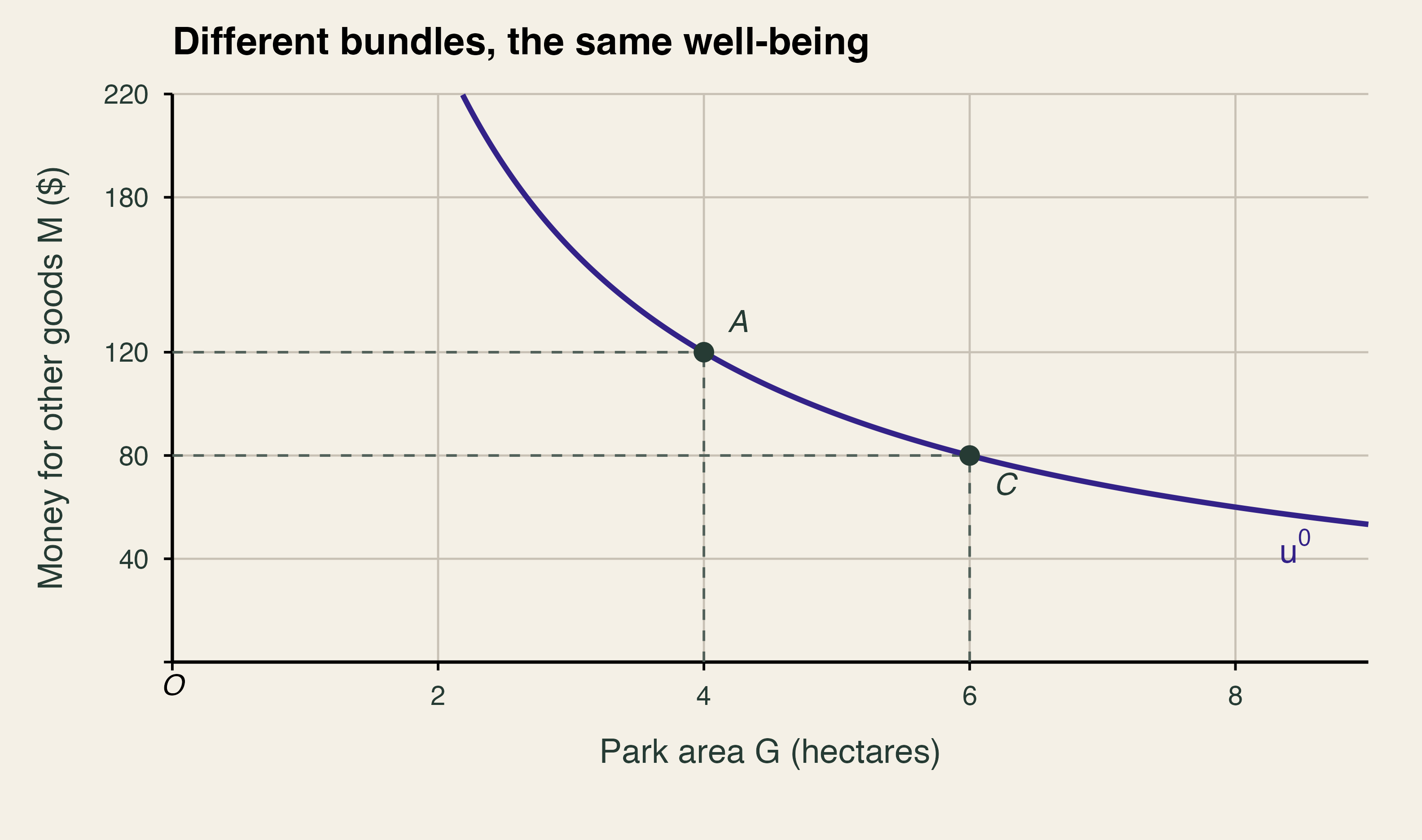
Willingness to Pay and Willingness to Accept
Environmental quality, money, and well-being
A reading companion explaining WTP, WTA, indifference curves, and reference outcomes through a worked park example.
NoteConnection to Lecture 7
Point labels A, B, C, and D match the WTP/WTA diagram in Lecture 7.
A park has value even without an admission price
A nearby park can provide space to walk, shade, habitat, and a place to spend time with friends. A person may also value preserving it for future generations, even if they rarely visit. These benefits do not disappear because the park charges no admission fee.
To compare a proposed environmental change with other uses of resources, economists often ask a money question: How much would someone give up to obtain a benefit, or how much compensation would they require to accept a loss? WTP and WTA express these trade-offs. They measure a person’s valuation of a specified change, rather than a single price for nature as a whole.
Two questions: paying and accepting compensation
Willingness to pay (WTP) is the most someone would pay to obtain an environmental improvement or prevent an environmental loss.
Willingness to accept (WTA) is the least compensation someone would accept for an environmental loss or for giving up an environmental improvement.
The words most and least matter. Someone might willingly pay both $10 and $20 for a park improvement, but their WTP identifies the highest acceptable payment. Someone might accept either $100 or $200 as compensation, but their WTA identifies the lowest acceptable amount.
| Situation | Question being asked | Measure |
|---|---|---|
| A park could be expanded. | What is the most you would pay for the expansion? | WTP |
| An existing park could be reduced. | What is the most you would pay to prevent the reduction? | WTP |
| An existing park could be reduced. | What is the least compensation you would accept for the reduction? | WTA |
| A promised expansion could be canceled. | What is the least compensation you would accept instead of receiving the expansion? | WTA |
Thus, WTP is not limited to improvements, and WTA is not limited to the loss of something already in use. Identify the alternatives and whether the person pays or receives compensation.
Indifference curves: different bundles, the same well-being
Suppose a resident values two things: the area of a nearby park, denoted by G, and money available for other goods, denoted by M. A bundle is one combination of park area and money.
We write the resident’s preferences as
U(G,M).
Here, utility means a way of representing how the person ranks bundles. An indifference curve connects combinations that leave the person equally well off. For this resident, more park area can offset having less money, and more money can offset having less park area.
For the worked example, assume
U(G,M)=G\times M.
This simple formula lets us check which bundles provide the same well-being without calculus. It is an assumption for the example, not an estimated preference function for an actual park. All transfers below are one-time amounts for one resident, and the initial amount available for other goods is $120.
For example,
\begin{aligned} U(4,120)&=4\times120=480,\\ U(6,80)&=6\times80=480. \end{aligned}
The person is equally well off with a 4-hectare park and $120, or a 6-hectare park and $80. These bundles lie on the same indifference curve.
ImportantUtility labels are not dollars
The numbers 480 and 720 below are labels generated by the chosen utility function. They are not money amounts, and 720 does not mean the person is “50% happier” than at 480. Money differences, measured on the vertical axis, give WTP and WTA.
WTP: paying for a larger park
Separate the improvement from the payment
Start at A: the park covers 4 hectares, and the resident has $120 for other goods. Their original well-being is u^0=480.
- The improvement is A to B. The park expands from 4 to 6 hectares while money stays at $120. The resident reaches a higher indifference curve, u^1=720.
- Now consider a payment at the larger park. Paying reduces money available for other goods, so the bundle moves down from B toward C.
- At C, the resident is as well off as at A. The larger park and $80 give the same well-being as the smaller park and $120.
The most the resident would pay is therefore
\mathrm{WTP}=120-80=\$40=\overline{BC}.
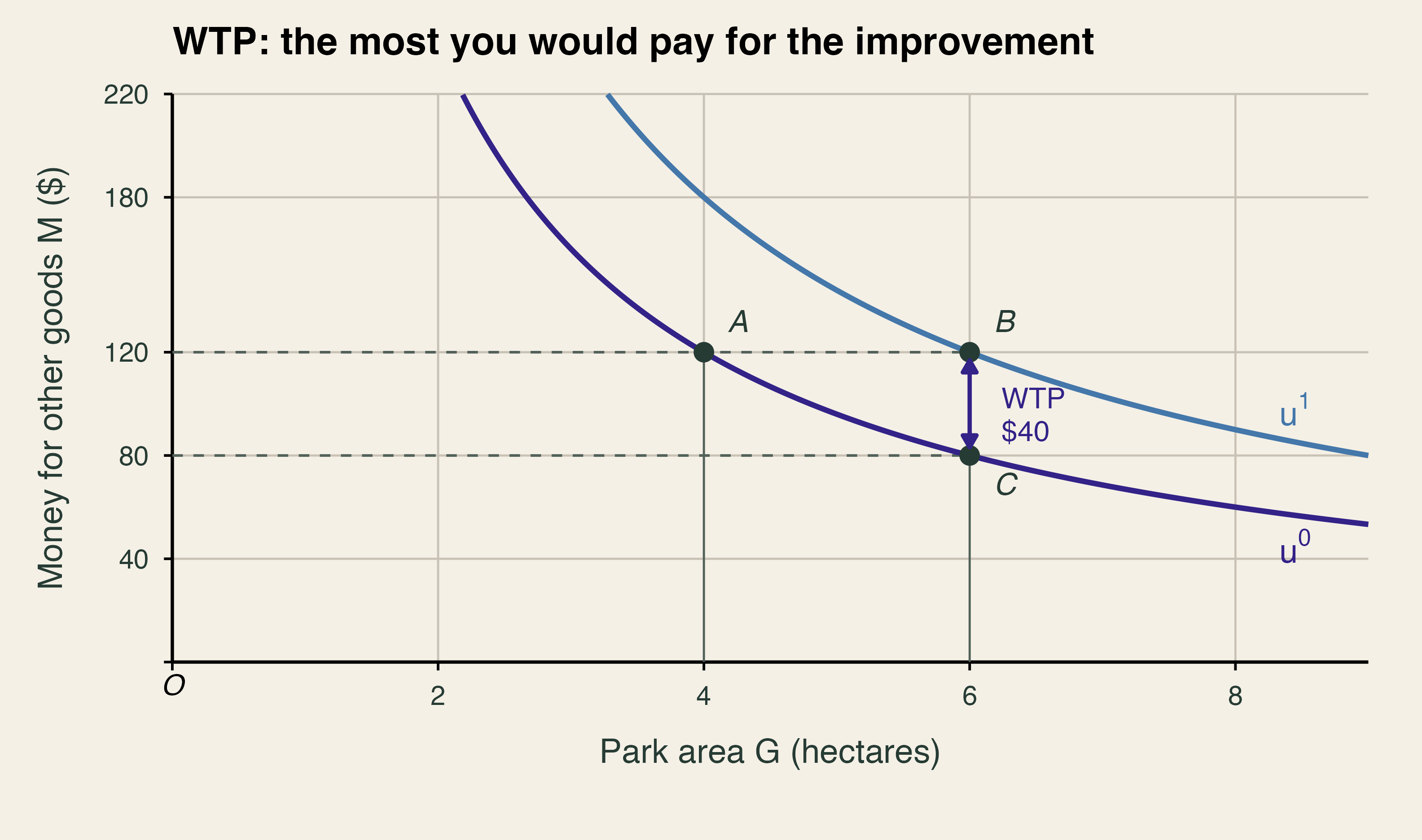
B to C is not an environmental improvement. Park area stays at 6 hectares while money falls. Well-being falls from u^1 at B to u^0 at C. The complete comparison is between A before the improvement and C after the improvement and payment.
A payment below $40 would leave the resident better off than at A. A payment above $40 would leave them worse off. That is why $40 is the most, rather than just an amount they might pay.
Express the same idea with a utility equation
Let G_0=4, G_1=6, and M_0=120. The defining comparison is
U(G_1,M_0-\mathrm{WTP})=U(G_0,M_0).
With our assumed utility function,
\begin{aligned} 6(120-\mathrm{WTP})&=4(120),\\ 720-6\mathrm{WTP}&=480,\\ 6\mathrm{WTP}&=240,\\ \mathrm{WTP}&=40. \end{aligned}
The graph and the equation answer the same question: How much money can be given up at the improved park area while preserving original well-being?
WTA: accepting a smaller park
Keep the higher well-being as the reference
Now suppose the resident already enjoys the 6-hectare park and has $120: bundle B, with well-being u^1=720. A proposal would reduce the park to 4 hectares.
- The degradation is B to A. With no compensation, money stays at $120 and well-being falls to u^0=480.
- Compensation changes money at the smaller park. Moving upward from A adds money, but it does not restore the lost park area.
- At D, the resident is as well off as at B. A 4-hectare park and $180 provide the same well-being as a 6-hectare park and $120.
The least compensation the resident would accept is
\mathrm{WTA}=180-120=\$60=\overline{AD}.
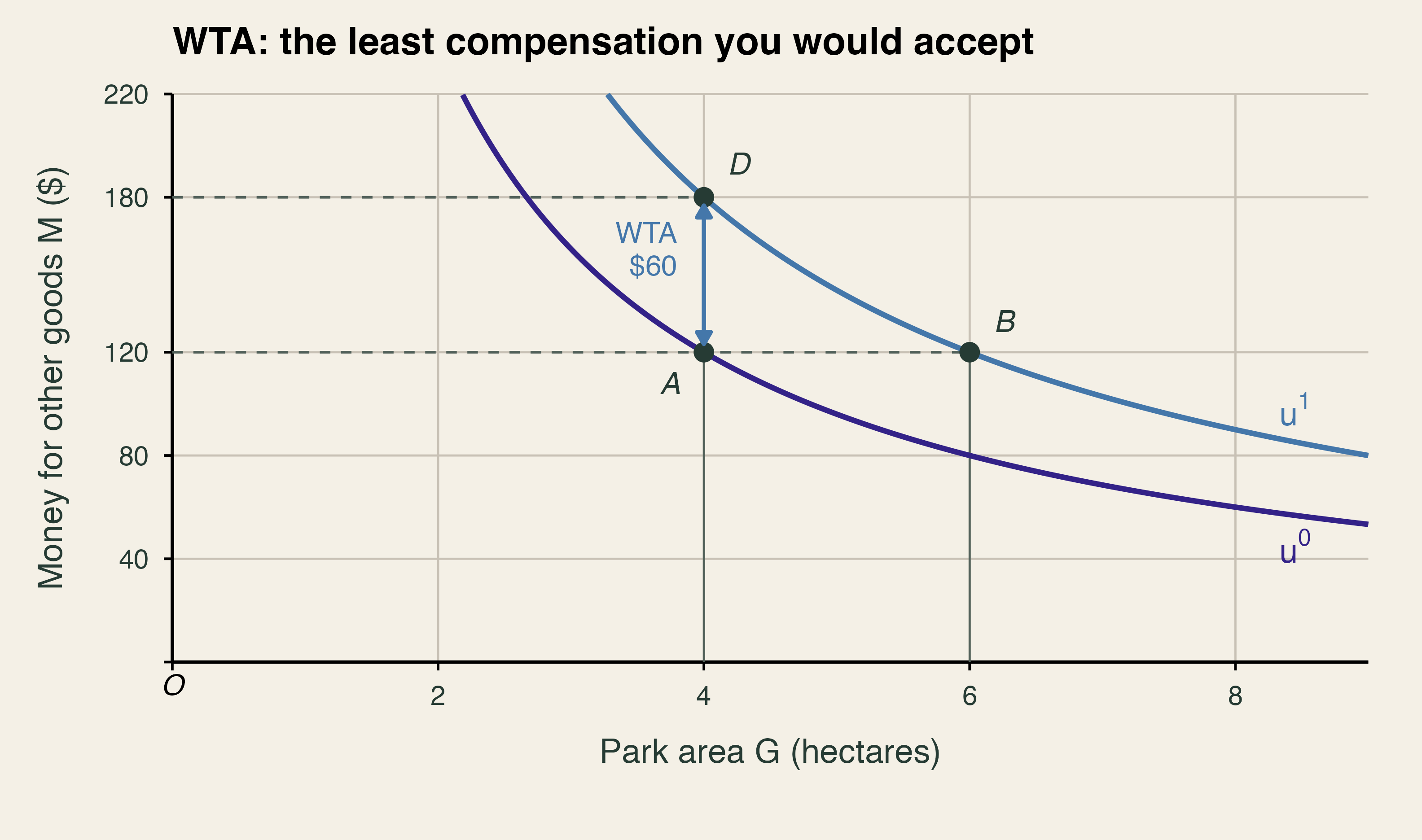
Compensation below $60 would fail to restore the reference well-being. The resident would also accept a larger payment, but $60 is the least amount that makes the loss acceptable under these assumed preferences.
Express the compensation requirement
The defining comparison is
U(G_0,M_0+\mathrm{WTA})=U(G_1,M_0).
Therefore,
\begin{aligned} 4(120+\mathrm{WTA})&=6(120),\\ 480+4\mathrm{WTA}&=720,\\ 4\mathrm{WTA}&=240,\\ \mathrm{WTA}&=60. \end{aligned}
The key difference from WTP is which well-being level is preserved. WTP for the expansion preserves the lower level at A; WTA for the reverse loss preserves the higher level at B.
Keep the four bundles straight
| Bundle | Park area | Money for other goods | Well-being | Interpretation |
|---|---|---|---|---|
| A | 4 hectares | $120 | u^0=480 | Smaller park, no transfer |
| B | 6 hectares | $120 | u^1=720 | Larger park, no transfer |
| C | 6 hectares | $80 | u^0=480 | Larger park after paying $40 |
| D | 4 hectares | $180 | u^1=720 | Smaller park after receiving $60 |
The useful equalities are U(A)=U(C) and U(B)=U(D). The vertical two-headed segments measure money gaps; they do not show changes in park area.
Preventing a loss and forgoing an improvement
The comparison can also be framed in two other ways.
WTP to prevent a loss. Suppose the resident has the larger park, but it will shrink unless a preservation proposal is adopted. Compare keeping the larger park and paying $40 (C) with allowing it to shrink and paying nothing (A). These bundles give the same well-being. Thus, in this example, $40 is also the most the person would pay to prevent the loss. This payment is compared with the outcome if the loss occurs, rather than with keeping the larger park for free.
WTA to forgo an improvement. Suppose a larger park has been promised, but the proposal might be canceled. Compare receiving the expansion without compensation (B) with retaining the smaller park and receiving $60 (D). These bundles also give the same well-being. The resident’s WTA to give up that improvement is $60.
These are valuation questions, not claims that compensation is legally required. A policy analysis must state which outcome is expected or protected and what change people are being asked to accept.
Choose the measure from the decision
Before collecting or interpreting a WTP or WTA amount, specify:
- The environmental change. What exactly improves, deteriorates, is preserved, or is forgone?
- The comparison outcome. What happens without the payment, project, or compensation? Which situation is treated as the starting entitlement or expectation?
- The direction of the transfer. Is the person being asked to pay or to accept compensation?
- The scope of the amount. Is it per person or household, one-time or annual, and for what duration and population?
These choices help determine what the number means. WTA in this reading is compensation for relinquishing an environmental benefit; it is not a harvesting-cost or production-supply curve.
Check your understanding
- In the WTP diagram, which change is the environmental improvement: A to B or B to C?
- Would $50 compensate the resident for reducing the park from 6 to 4 hectares in the worked example?
- Which bundles have the same well-being?
- If someone pays to prevent the park from shrinking, is the measure WTP or WTA?
TipCheck your answers
- A to B is the environmental improvement. B to C reduces money while park area stays fixed.
- No. After receiving $50, utility would be 4(120+50)=680, below the reference level of 720 at B. The minimum compensation is $60.
- A and C give the same well-being, u^0=480. B and D give the same well-being, u^1=720.
- WTP. The person pays to prevent a loss. WTA would ask for compensation to accept that loss.